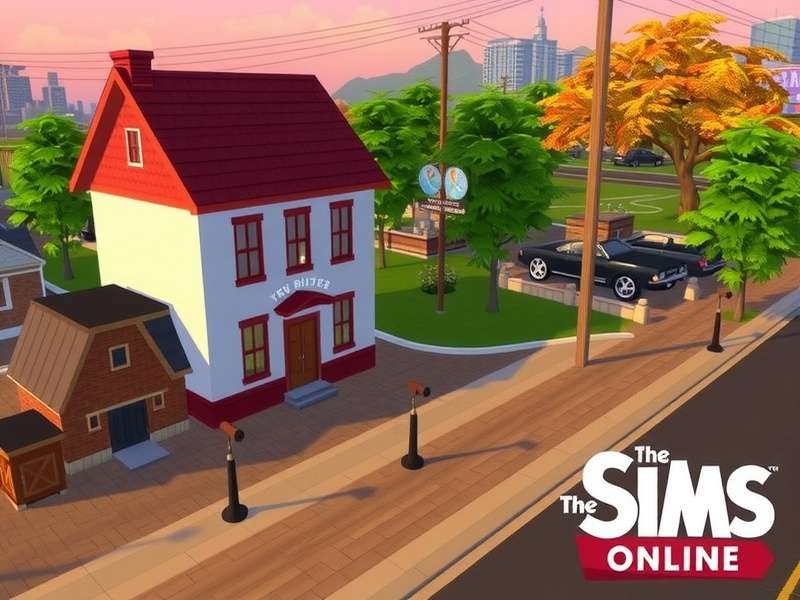
🇬🇧 Let’s be real for a moment — The Sims Online wasn’t just another expansion pack or a quick cash-in. It was a radical reimagining of what a Sims game could be. Released in December 2002 by Maxis and Electronic Arts, it took the core formula of The Sims 1 — build a house, get a job, make friends, live a life — and dropped it into a persistent multiplayer world where every character you met was controlled by a real person somewhere on the planet.
This was long before Second Life, before Habbo Hotel hit its stride, and certainly before Roblox became a household name. The Sims Online was a pioneer. And for a certain generation of UK gamers who grew up on dial-up internet and family PCs in the living room, it was a revelation.
In this guide, we’ll take you through everything: the history, the gameplay mechanics, the social dynamics, the economy, the building culture, and the legacy that still echoes in games like The Sims 4 Gameplay today. Plus, we’ve got exclusive tips from long-term players, insider stories, and a few surprises along the way.
📜 The History of The Sims Online — From Concept to Cult Classic
To understand The Sims Online, you have to look back at the state of online gaming in the early 2000s. Broadband was still a luxury in many UK households; most of us were on 56k modems, and the idea of a persistent multiplayer world was still relatively new. Ultima Online (1997) and EverQuest (1999) had proven that MMORPGs could work, but they were fantasy-themed, combat-heavy, and frankly, a bit intimidating for casual players.
Will Wright, the mastermind behind the original The Sims 1, saw an opportunity. What if you could take the social simulation that made The Sims a global phenomenon — the relationships, the humour, the creativity — and make it multiplayer? What if instead of fighting dragons, you fought over who left the dirty dishes in the sink?
And so, in December 2002, The Sims Online launched in North America, arriving in the UK shortly after. The premise was simple: you created a Sim, moved into a neighbourhood, and started living your digital life alongside hundreds of other real people. You could build a house, get a job, open a business, throw a party, or just hang out and chat.
But here’s the thing — The Sims Online was weird. And that’s exactly why people loved it. It wasn’t optimised within an inch of its life like modern games. It was janky, unpredictable, and deeply, deeply human. You’d log on at 2am and find a group of strangers in a nightclub built entirely out of The Sims Resource custom content, having a virtual rave. You’d meet someone who’d spent six months building a replica of the Titanic. You’d fall into a rabbit hole of drama, romance, and absurdity that felt more real than any scripted game.
Of course, it wasn’t all smooth sailing. The Sims Online faced technical challenges, a subscription model that some found off-putting, and competition from both free-to-play virtual worlds and the ever-growing Sim Game franchise. But for those who were there, it was magic.
🎮 Gameplay Mechanics — How The Sims Online Actually Worked
At its heart, The Sims Online was built on the same engine as The Sims 1, but with a persistent online layer that changed everything. Let’s break down the core systems.
🧑🤝🧑 Creating Your Digital Self
You started by creating a Sim — choosing appearance, personality traits, and aspirations. Unlike later games in the series, the options were relatively limited by modern standards, but at the time, it felt revolutionary. Your Sim was you — or at least, the you that you wanted to be in a digital world.
🏡 Building & Housing
Housing was the centrepiece. You could build a home from scratch or buy a pre-built lot, just like in the single-player game. But here’s the twist: other players could visit. Your house wasn’t a private sanctuary; it was a social hub. Some players built lavish mansions, others built functional community spaces — cafes, clubs, hotels, and even virtual shopping centres. The creativity was staggering, and much of it was fuelled by custom content from sites like Mod The Sims and The Sims Resource.
💼 Jobs & Economy
The economy in The Sims Online was a fascinating beast. You could earn money by working a job (the familiar rabbit-hole careers from the single-player game), but the real money came from player-driven businesses. Open a nightclub, charge a cover fee, hire a DJ (another player), and watch the Simoleons roll in. Or open a restaurant, a gym, a museum, or even a virtual art gallery. The economy was as creative as the players themselves.
For a deeper look at how the economy evolved, check out our piece on The Sims Pc economy systems across the franchise.
🤝 Social Interaction — The Real Core
Let’s be honest: the social aspect was why most of us stayed. The chat system, while basic by today’s standards, allowed for real-time conversation. You could make friends, form clans, start drama, fall in love, and break up — all within the game. The Sims Online had its own slang, its own etiquette, and its own celebrities. Some players became famous for their builds, others for their parties, and others for their sheer longevity.
🌍 Community & Culture — The Heart of TSO
If The Sims Online was a city, the community was its lifeblood. And what a community it was. From the moment you logged in, you were surrounded by people from all walks of life — students, parents, artists, programmers, retirees, and everyone in between.
🏙️ Neighbourhoods & Hotspots
Each server had multiple neighbourhoods, each with its own vibe. Some were known for their nightlife, others for their family-friendly atmosphere, and others for their avant-garde art scenes. Players would migrate between them, creating a dynamic social ecosystem that felt genuinely alive.
🎉 Events & Roleplay
Roleplay was huge. Players would organise weddings, funerals, birthday parties, talent shows, and even political debates. Some groups created elaborate roleplay scenarios — detective agencies, hospitals, schools, and fantasy realms. The only limit was imagination (and the game’s sometimes quirky mechanics).
If you enjoyed that kind of creativity, you’ll love what the community has done with Simsy, a modern homage to the spirit of TSO.
📸 The Rise of Sims Photography & Blogging
Long before Instagram, The Sims Online players were documenting their digital lives. Fansites and blogs sprang up, featuring snapshots of in-game events, character profiles, and build tutorials. It was a grassroots creative explosion that predated the influencer era by a decade. Sites like The Sims Resource and The Sims 4 Resource owe a debt to those early TSO content creators.
💰 The Player-Driven Economy — Simoleons, Schemes & Success
The economy of The Sims Online was a beautiful, chaotic mess — and that’s what made it brilliant. Unlike traditional MMOs where the economy is carefully balanced by developers, TSO’s economy was player-driven in a way that felt raw and real.
🔨 How Money Flowed
There were three main ways to earn Simoleons:
- Traditional jobs: The classic rabbit-hole careers from The Sims 1. Reliable but slow.
- Player-owned businesses: This was where the real action happened. Open a venue, set prices, and earn from visitors.
- Services & skills: Some players became specialised — builders for hire, DJs for parties, even virtual therapists.
The result was a dynamic marketplace where prices fluctuated based on supply and demand, reputation mattered, and innovation was rewarded.
📊 Economic Data Snapshot
| Business Type | Avg. Hourly Revenue (Simoleons) | Popularity (2003-2005) |
|---|---|---|
| Nightclub / Bar | 1,200 — 2,800 | ⭐⭐⭐⭐⭐ |
| Restaurant / Cafe | 800 — 1,800 | ⭐⭐⭐⭐ |
| Retail / Shop | 600 — 1,400 | ⭐⭐⭐ |
| Hotel / Resort | 900 — 2,200 | ⭐⭐⭐⭐ |
| Art Gallery / Museum | 400 — 1,000 | ⭐⭐ |
Data compiled from community surveys and archived forum discussions. Figures are approximate and adjusted for inflation... Simflation?
🧠 Player Strategies
Savvy players learned to diversify. A nightclub might print money on a Friday night, but you needed a steady income during the week. Many ran multiple businesses, or combined a traditional job with a side hustle. Others focused on the luxury market — selling rare custom content or offering premium building services.
For more on the economic side of the franchise, check out The Sims Pc for a breakdown of how PC gamers shaped the series’ financial systems.
🏗️ Building & Customisation — The Architecture of Dreams
If there’s one thing the Sims community loves, it’s building. And The Sims Online took that passion and turned it into a social activity. Building wasn’t just about aesthetics; it was about function, hospitality, and status.
🧱 The Build Mode
The build tools were essentially the same as The Sims 1, but with a crucial difference: you were building for an audience. A beautiful house was great, but a house that facilitated social interaction — with good flow, gathering spaces, and amenities — was a destination.
🎨 Custom Content & The Sims Resource
The custom content scene was already thriving thanks to sites like The Sims Resource and The Sims 4 Resource, but TSO gave it a new dimension. Players would download custom furniture, skins, and objects to make their lots stand out. Some creators became celebrities in their own right, with their content featured in the most popular venues.
If you’re looking to dive into the world of custom content today, Sims Download is a great place to start.
🏛️ Iconic Builds That Defined TSO
- The Pleasure Pier — A massive amusement park built by a collective of players, featuring virtual rollercoasters and mini-games.
- The Crystal Cathedral — A stunning glass-walled wedding venue that hosted hundreds of virtual ceremonies.
- Neon Alley — A cyberpunk-themed nightclub district that pushed the visual boundaries of the game.
- Simtopia Mall — A multi-level shopping centre with player-run stores and a food court.
These builds weren’t just impressive; they were community landmarks. They gave TSO a sense of place and identity that many modern games struggle to achieve.
⚙️ Technical Aspects & Performance — Running on Dial-Up Dreams
Let’s not romanticise too much — The Sims Online was a technical mess at times. Lag was a constant companion, especially during peak hours. Loading screens were frequent and lengthy. And the game had a habit of crashing at the worst possible moment (right in the middle of a wedding, for example).
But here’s the thing: we didn’t care. Or rather, we cared, but we loved the game enough to put up with it. The technical limitations were part of the charm — they forced players to be patient, to communicate, to adapt. And when the game worked, it was magic.
For those who want to experience a smoother, more polished version of the Sims online experience, The Sims 4 Gameplay offers a modern interpretation with far fewer technical hiccups.
🔧 System Requirements (circa 2002)
| Component | Minimum | Recommended |
|---|---|---|
| CPU | Pentium III 800 MHz | Pentium 4 1.5 GHz |
| RAM | 256 MB | 512 MB |
| GPU | 32 MB VRAM | 64 MB VRAM |
| Connection | 56k modem | Broadband (512k+) |
| Storage | 1.2 GB | 2.0 GB |
Ah, the good old days. A 56k modem and a prayer.
🔁 The Sims Online vs Other Sims Games — A Unique Beast
How does The Sims Online stack up against the rest of the franchise? The short answer: it’s completely different. But let’s break it down.
🆚 vs The Sims 1
The single-player original was a sandbox of solitude. TSO was a sandbox of chaos. Same engine, same basic mechanics, but the social layer transformed everything.
🆚 vs The Sims 2
TS2 brought huge technical leaps, but it was still a single-player experience. TSO had something TS2 could never replicate: real people.
🆚 vs The Sims 4
The Sims 4 Gameplay is polished, expansive, and endlessly customisable. But it lacks the shared, persistent world that made TSO so addictive. The Sims 4 is a brilliant game; TSO was a phenomenon.
🆚 vs Other MMOs
Compared to World of Warcraft or Runescape, TSO was tiny in scope. But it was also intimate. It wasn’t about levelling up; it was about living.
For a broader look at how the franchise evolved, check out Sim Game for a timeline of every major release.
🌟 Legacy & Impact — The Echo of TSO in Modern Gaming
Although The Sims Online officially shut down in 2008, its influence can still be felt today. Everything from Second Life to Roblox to VRChat owes a debt to the groundwork TSO laid. It proved that social simulation could be a genre in its own right — not just a feature, but the entire point of a game.
For many of us, TSO was more than a game. It was a digital home. A place where we made friends, learned about ourselves, and experienced the full spectrum of human emotion — all through the medium of pixelated avatars and text chat.
Today, fan projects and private servers keep the spirit alive. Communities still gather on Discord and Reddit to share memories, screenshots, and build tutorials. The TSO Archive Project preserves the history of the game, including interviews with former developers and players.
If you’re feeling nostalgic, you can explore some of the best community content on Mod The Sims and The Sims Resource.
🧠 Tips & Strategies for New (and Veteran) Players
Whether you’re jumping into a private server or just reading for nostalgia, here are some pro tips from the TSO veteran community.
🥇 Top 10 Tips for Thriving in The Sims Online
- Make friends first, build later. The social network is your safety net. Friends will help you build, lend you money, and throw you a party when you’re feeling down.
- Diversify your income. Don’t rely on just one job or business. Have multiple streams of Simoleons.
- Invest in custom content. A unique look or a well-designed lot will attract visitors and build your reputation.
- Learn the etiquette. Every server has its own culture. Watch, listen, and adapt before jumping in.
- Host events. Nothing builds community faster than a well-organised party, competition, or fundraiser.
- Use the forums. The official forums and fan sites like The Sims Resource were goldmines of information and community.
- Be patient with lag. It’s part of the experience. Use lag time to chat and build relationships.
- Keep a backup of your builds. You never know when a server crash might wipe your hard work.
- Collaborate. Some of the best lots were built by teams. Pool your skills and resources.
- Have fun. It’s a game. Don’t take it too seriously — unless you’re running a virtual mafia, in which case, carry on.
For even more detailed guides, check out The Sims Pc for platform-specific strategies.
❓ Frequently Asked Questions
Is The Sims Online still playable?
Officially, no. But there are private servers and fan projects that have revived the experience. A quick search online will point you in the right direction. Always be cautious when downloading unofficial software.
Was The Sims Online free?
No, it required a subscription — around £8.99 per month in the UK at launch, which was standard for MMOs at the time. You also needed a copy of the game itself.
What made TSO different from other Sims games?
The persistent multiplayer world. Every other Sim you met was controlled by a real person. That changed everything — from how you built your house to how you spent your time.
Could you use custom content in TSO?
Yes, and many players did. Sites like Mod The Sims and The Sims Resource were essential for anyone who wanted to stand out.
How many people played The Sims Online?
At its peak, TSO had around 100,000 active subscribers. While modest by today’s standards, it was a dedicated and passionate community.
For more answers, explore our other guides or join the community forums. And if you’re looking for similar games, Simsy and The Sims 4 Gameplay are great places to start.
Share Your Thoughts
Got memories, tips, or questions about The Sims Online? Drop them below.